Today is Tuesday, June 16, 2026. Across the Indian subcontinent, the academic session has transitioned from early startup orientation to full operational momentum. As school trustees, regional promoters, and chief financial controllers of multi-campus educational networks coordinate daily operations, they inevitably confront one of the most resource-intensive and leak-prone nodes in the entire academic ecosystem: transport and fleet operations. Establishing a bulletproof, leak-free billing structure with the best school management system is not merely an operational convenience; it is a critical fiduciary requirement to insulate corporate education groups from severe revenue loss.
1. The Mid-June Routing Crisis: Operational Chaos Meets Revenue Exposure
As we pass the mid-June milestone, private school networks in regions like **Sonipat**, **Gurugram**, **Faridabad**, **Panchkula**, **Ludhiana**, and **Amritsar** are experiencing their most intense transport coordination challenge. Routes are being finalized, bus capacities are reaching their absolute limits, and driver rosters are stabilizing.
However, this operational stabilization is accompanied by a massive influx of parent requests. Front-office teams and transport coordinators are overwhelmed with last-minute demands: stop shifts, temporary route adjustments, requests for zone upgrades to accommodate new residential locations, and student drop-off changes.
In a traditional school network operating on siloed platforms, this rush leads directly to an executive blind spot. When the transport desk operates independently of the finance department, modifications to student routes are frequently handled verbally, via paper slips, or through localized WhatsApp messages sent directly to drivers.
As a result, central management completely loses track of exact student transport billing allocations. A student may be approved for a longer, higher-tariff route extension, yet they continue to be billed at their initial, shorter distance rate. The bus physical load increases, fuel consumption escalates, and driver hours extend, but the corresponding revenue adjustments never materialize on the student ledger.
2. Exposing the Three Main Transport Revenue Leaks
During peak June operations, transport revenue does not disappear in large, easily noticeable transactions. Instead, capital leaks out through hundreds of small, unmonitored inconsistencies across the fleet. In our audits of multi-campus educational institutions, we consistently identify three primary leakages:
Leak 1: The Untracked Route Drift
Route drift occurs when a student boards a bus or utilizes a longer route extension without an automated, matching zone-upgrade fee instantly hitting their master student ledger.
For example, a student initially registered for a 0–5 km radius zone (Zone A) moves to a new residence situated in a 10–15 km zone (Zone C). They verbally request the transport coordinator to adjust their pickup. The coordinator agrees and instructs the driver. The student boards the bus daily on the extended route, occupying a premium seat.
Because the transport coordinator operates on a localized system, this change is never shared with the finance desk. The student's family continues to pay the lower Zone A fee. In a school group managing 5,000+ transport users across 15 campuses, if just 6% of students slide into a higher route tier without a corresponding billing adjustment, the unrecorded leakage can exceed ₹18,00,000 annually in direct operating margins.
Leak 2: The Double-Subsidy Trap
In large school groups, front-office desks are under constant pressure to process verbal transport waivers, sibling discounts, and special staff allocations.
Without a unified **school ERP software**, these discounts are manually entered by staff members who lack visibility into the actual operating costs of specific routes. The system allows sibling discounts or custom waivers to be applied to transport fees, even when the seat's direct marginal cost—calculated by factoring in fuel consumption, vehicle depreciation, and driver salaries—exceeds the discounted price.
In effect, the school double-subsidizes the run: once through the general sibling discount and again by failing to validate the discount against route-specific overheads. This directly erodes the transport department's operating margins, turning what should be a self-sustaining service into an active drain on the school's general funds.
Leak 3: Fragmented Third-Party Vendor Tracking
Many elite educational groups outsource their fleet requirements to third-party contractors. These vendors charge based on complex, non-standard contracts, including wet leases, per-kilometer rates, guaranteed seat thresholds, or flat-rate route allocations.
When vendor tracking is managed on paper logs or disconnected spreadsheets, reconciling vendor payouts against actual seat collections becomes nearly impossible. Schools frequently pay contractors for full route capacities, dry runs, and phantom vehicle allocations, even when actual student boarding data indicates low seat utilization.
Without automated, route-by-route seat reconciliation, schools systematically overpay contractors while under-billing the participating students. This dual-sided discrepancy represents one of the largest hidden operational leaks in Indian private education today.
Financial Comparison: Manual vs. Centralized Transport Billing
| Operational Metric | Siloed Manual System | Classegy Centralized Engine | Net Financial Impact |
|---|---|---|---|
| Route Drift & Stop Changes | Verbal approvals; 8-12 weeks average billing lag | Instant routing and automated ledger updates | +100% Leakage Containment |
| Sibling & Staff Subsidy Auditing | Manual waivers; zero route margin checks | System-enforced minimum cost controls | +6-8% Operating Margin Recovery |
| Vendor Invoice Reconciliation | Paper log sheets; manual monthly audits | Automated passenger checks vs vendor logs | Up to 15% Reduction in Vendor Costs |
| Regulatory Audit Trials | Fragmented records; missing transport history | Immutable, permanent safety and billing logs | 100% Tax & Compliance Safety |
3. The Fixed System: Configuration-First Route and Zone Mapping
To eliminate these leakages, school boards must escape the "SaaS Trap"—cheap, low-cost school management systems that rely on hard-coded transport configurations or require custom developer code every time a new distance zone, route tier, or discount rule is introduced.
If a school group operates across multiple states, its **best enterprise school management software** must be highly adaptable. It must support diverse regulatory requirements and dynamic pricing structures without requiring expensive software modifications.
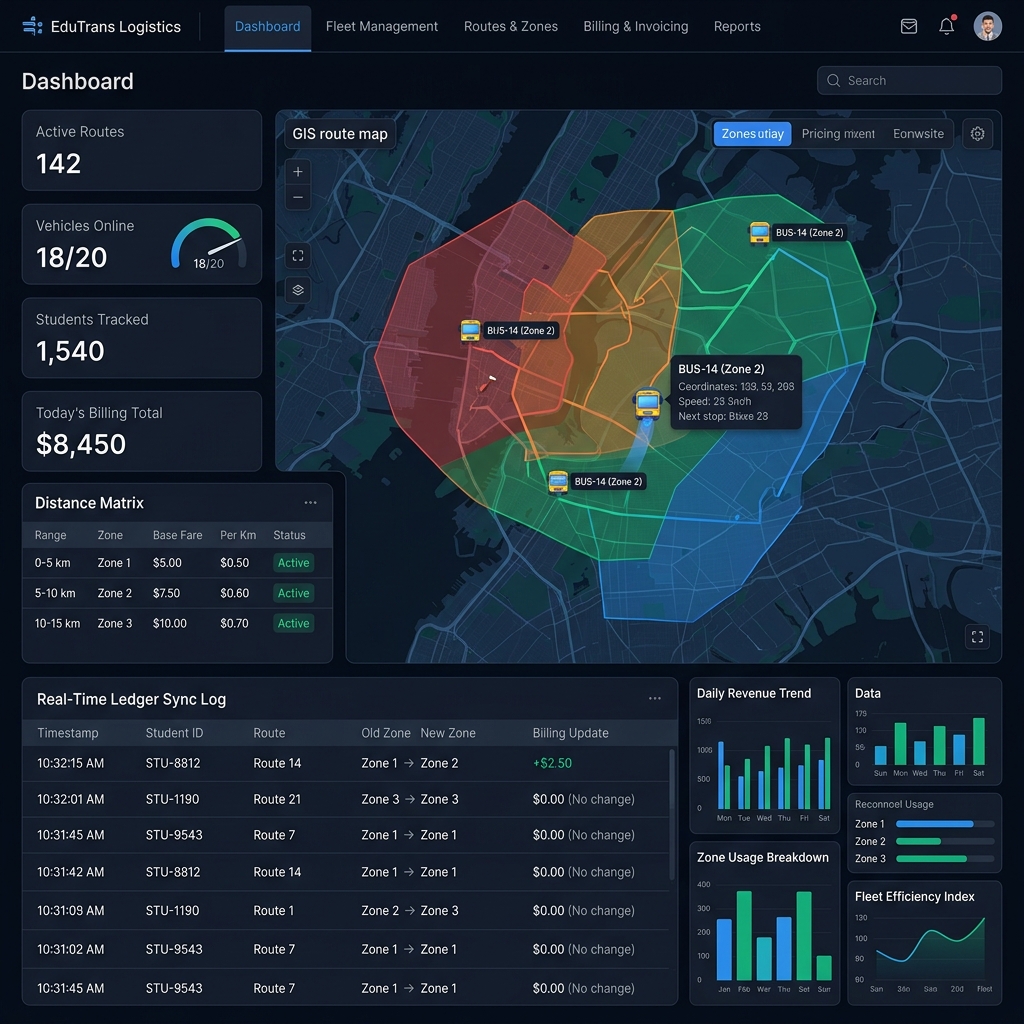
Classegy solves this challenge with a generic, configuration-over-customization transport engine. Rather than using rigid tables, Classegy enables financial controllers to build flexible, dynamic distance matrices and transport zone hierarchies that instantly bind to clean accounting sub-ledgers.
Through an intuitive dashboard matrix, admins can configure:
- Dynamic GIS Distance Zones: Set up zones based on radial distance or route stops (e.g., Zone 1: 0–3 km, Zone 2: 3–6 km, Zone 3: 6–12 km) that automatically calculate fees based on the student's registered home address.
- Multi-Campus Ledger Mapping: Bind each route and zone to specific accounting heads (e.g., Transport Revenue - Gurugram Campus, Fleet Fuel Expense - Jaipur Campus) to ensure clean financial tracking across the entire network.
- Unified Cross-State Control: Manage fee rules, vendor contracts, and tax structures across **11 states** using a single, unified database dashboard.
When a transport admin in **Noida**, **Jaipur**, **Kota**, or **Ahmedabad** assigns a student to a route, the **cloud-based school management platform** automatically calculates the appropriate zone fee, applies the relevant tax rules, and updates the student's ledger. This happens in real time, eliminating manual data entry and ensuring billing accuracy.
4. Real-Time Data Integrity and the Law of Permanent Records
Transport logistics involve significant compliance and legal responsibilities. In major educational hubs like the Delhi NCR, Haryana, and Maharashtra, regulatory authorities mandate strict records of student transport usage for safety, tax compliance, and auditing.
A major flaw in legacy school management systems is the ability to delete student records. When a student leaves or stops using transport mid-session, staff members often delete the allocation record to clean up lists.
This practice creates substantial compliance and security risks. Deleting a record removes the historical tracking data, student safety logs, and transaction audit trails. If an incident occurs on a route, or if tax authorities audit the school's transport revenue, missing records can lead to legal penalties and reputational damage.
Classegy prevents this risk with a strict data lifecycle rule: a student's enrollment ID is a permanent legal record that can never be deleted.
If a student stops using transport mid-session in **Mumbai**, **Pune**, **Bengaluru**, **Hyderabad**, **Chennai**, or **Kolkata**, the system does not delete the allocation. Instead, the profile state transitions to **"Status: Left"** for that specific route. This locks the billing log to prevent future charges while keeping all historical route ledger trails, safety logs, and passenger lists intact.
AUDIT COMPLIANCE NOTICE
"Under corporate tax and educational safety frameworks, transport allocations must remain permanently traceable. Classegy's immutable records ensure that student movement and billing history are preserved for audit purposes, protecting school groups from regulatory penalties."
5. The Strategic Strategy Closer & Call to Action
For private school founders scaling operations across India, transport management is a core component of revenue protection. Operating transport fleets on disconnected systems is a major source of financial leakage and compliance risk.
To support educational networks in upgrading their administrative systems, Classegy is launching the **Institutional ROI Optimization Grant**.
Under this program, school networks that commit to a 3-year agreement will receive their first **6 months of Premium ERP deployment completely free**.
This grant is designed to offset the transition costs of moving from legacy databases to a centralized, cloud-based platform. It helps you secure your fleet capital, improve operational efficiency, and prepare your schools for scale.
Secure Your Transport Fleet Capital.
Discuss your multi-campus transport requirements and vendor reconciliation structures with our enterprise solution architects. Book an exclusive demonstration for your board of trustees this week.
Book a Private Demonstration