With the implementation of the National Education Policy (NEP 2020), educational governance across India is undergoing rapid and permanent modernization. In Punjab, a diverse academic ecosystem—spanning high-technology hubs in Mohali (SAS Nagar) and Phagwara, expansive school groups in Ludhiana and Amritsar, and established coaching zones in Moga and Bathinda—is leading this transformation. Yet, behind this growth, institutional chairmen, trustees, and directors face a persistent challenge: outdated manual processes and fragmented software are draining operational capacity and creating financial leakages.
1. The Modern Administrative Imperative in Punjab's Education Hubs
Punjab’s educational landscape is both vast and diverse. The **Doaba region**, particularly Jalandhar and Phagwara, is home to large universities and engineering colleges drawing students from across India. In the **Malwa educational belt**, cities like Ludhiana, Bathinda, and Patiala host prestigious boarding schools and coaching academies. Meanwhile, Amritsar and Pathankot support multi-generation public school groups.
Operating these campuses involves complex administrative challenges. When student details, fee ledgers, scheduling sheets, and exam results are kept in separate systems, coordination suffers. Front-office teams spend hours resolving registration errors, while registrars manually update student files for different boards, including the **Punjab School Education Board (PSEB)**, CBSE, and ICSE.
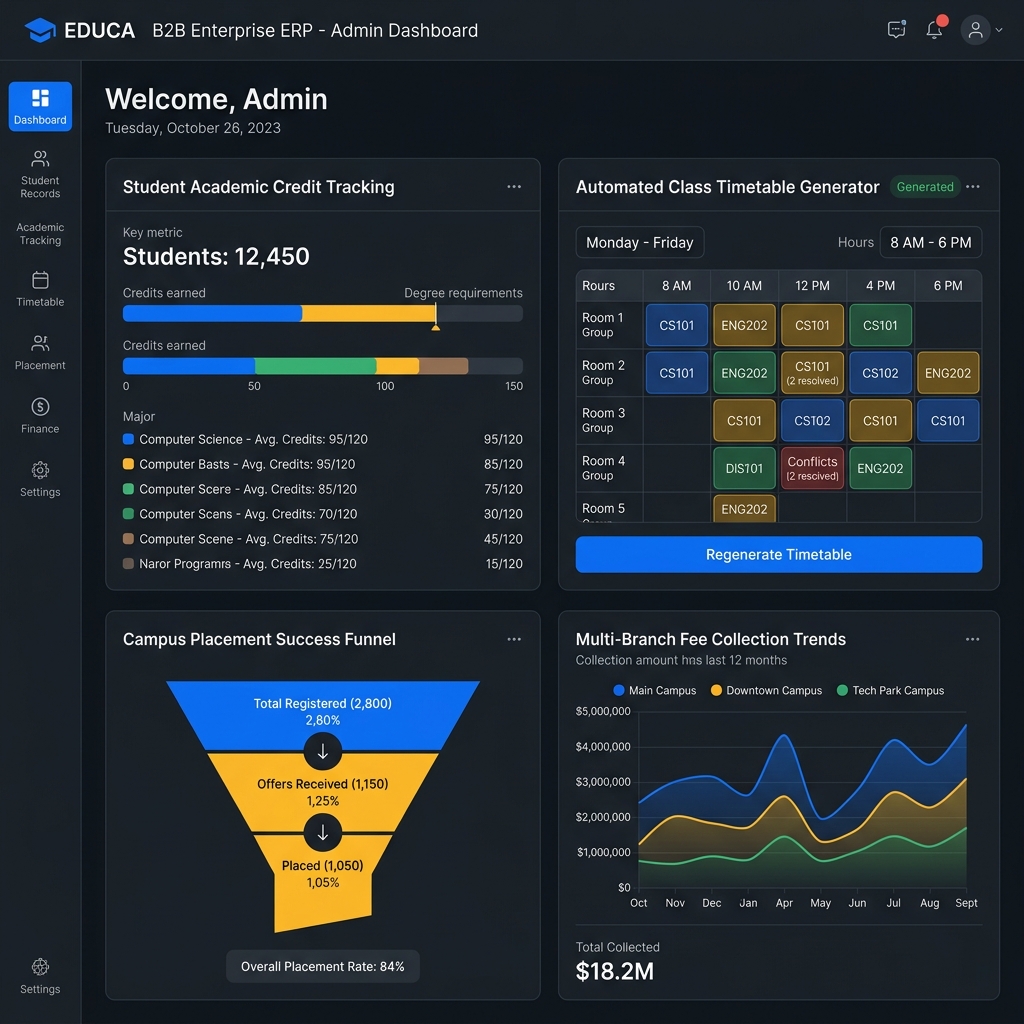
To scale effectively, institutions are moving away from simple software options toward a unified **School ERP software Punjab** solution. A modern ERP acts as a central operating system, automating routine tasks and giving administrators real-time visibility into their entire network.
2. Administrative Pain Points of Punjab's Institutes
Across campuses in cities like **Hoshiarpur**, **Pathankot**, and **Moga**, manual operations create significant business and financial risks:
- Multi-Campus Management Gaps: Educational groups running multiple campuses across different districts find it difficult to track operations centrally. Without unified software, comparing admission counts, fee collections, and staff attendance across branches is a slow, manual process.
- Attendance Tracking Bottlenecks: Manually recording attendance for thousands of students wastes valuable teaching time. In large districts like Hoshiarpur, tracking absent students and notifying parents is often delayed, raising security and communication concerns.
- Fee Collection Errors: Managing non-standard fee structures—which include tuition, transport zones, sibling discounts, and hostel fees—on separate sheets leads to reconciliation errors. Staff spend weeks trying to match bank deposits with student accounts, resulting in late fees and cash flow bottlenecks.
3. Core Modules of an Modern Educational ERP
A modern **College management system** or school ERP replaces separate applications with a single, integrated platform. Important modules include:
Seamless Fee Management
A centralized **school fee management software** automates the entire billing cycle. Parents receive automated payment links via SMS and WhatsApp, allowing them to pay securely online. The system updates the student's ledger instantly and sends receipts, eliminating manual entries. Administrators can monitor real-time collection dashboards, track outstanding balances by class, and manage concessions automatically.
Unified Student Information System (SIS)
The **Student information system (SIS)** acts as the core database, tracking a student from their initial admission inquiry to their graduation. It stores demographic details, academic records, fee history, attendance, and disciplinary logs. This central database ensures that all departments—from admissions to accounts and academic offices—work with the same, accurate information.
Advanced Examination & Result Portals
Using an **Online examination platform**, faculty can schedule assessments, grade assignments online, and calculate GPAs and grades automatically. This is particularly helpful for board compliance (PSEB, CBSE, ICSE), as report cards are generated directly from the database, preventing calculation errors and data entry delays.
Timetable and Scheduling Automation
An **Automated timetable generator** schedules classes, assigns rooms, and allocates teacher hours while preventing scheduling conflicts. It handles complex, multi-course university structures as well as standard school timetables, saving coordinators weeks of planning time before each semester.
Specialized IELTS and Coaching Tools
Given the high demand for study-abroad programs in Punjab, many institutions operate specialized IELTS and coaching centers. Classegy provides a dedicated **IELTS institute management tool** and **Coaching center billing software**. This module helps manage flexible, short-term batches, track inquiries and leads, schedule mock tests, and manage separate billing structures for students preparing for international exams.
4. Local Success Stories: How Punjab's Institutes Are Scaling
Centralizing administrative operations helps regional educational institutions run more efficiently and improve communication with students and parents:
College Operations in Jalandhar
A technical institute in **Jalandhar** used Classegy's **University ERP software** to centralize student academic profiles, elective course registrations, and placement data. This unified system reduced administrative workloads in the registrar's office by 40% and simplified placements by sharing real-time GPA and skill profiles directly with recruiters.
CBSE School App in Patiala & Pathankot
A large CBSE school network in **Patiala** and **Pathankot** improved communication by introducing Classegy's **best school management app India**. Parents can now track attendance, view homework, review grades, and pay fees from their mobile devices. This change reduced front-office inquiry calls by 60% and improved on-time fee collections.
5. Why Classegy is the Best Choice for Punjab’s Educators
When selecting a school or **Institute management software**, institutions must choose a platform that is secure, scalable, and easy to use. Classegy is designed to meet the needs of Punjab's schools and universities:
- Cloud Reliability & Security: Built on secure, high-speed servers, Classegy provides 99.9% uptime and roles-based access control, keeping student, financial, and staff data secure.
- User-Friendly Interfaces: Designed for simplicity, Classegy allows staff members to perform tasks, run reports, and update ledgers with minimal training.
- Dedicated Local Support: Our team of implementation specialists provides on-site setup, staff training, and ongoing technical support, helping your transition go smoothly.
- Scalable Multi-Tenant Architecture: Whether you manage a single campus with 200 students or a university network with 20,000 students, Classegy's cloud-based platform adapts to your scale.
6. Take the Next Step in Institutional Scale
Modernizing campus operations is essential for saving administrative time, preventing financial leakage, and improving communication with parents and students. Clunky, disconnected legacy software is no longer sufficient for progressive institutions.
Upgrade to a centralized, modern platform. Streamline your administration, secure your fees, and prepare your campus for growth.
Automate Your Punjab Campus Today.
Book a free, customized live demonstration with our Punjab regional product expert to discuss your institution's requirements.
Schedule a Free Demo Now